
Introduction
Copackaged optics did not emerge because the industry was looking for something new. It emerged because the architecture that had served data centre interconnects for decades was running out of runway. Traditional pluggable transceiver technology is a mature, well-understood system with a substantial installed base, a deep supply chain, and decades of operational reliability behind it. It is also a system whose fundamental physics impose constraints that become harder to engineer around as bandwidth requirements climb. Understanding the differences between copackaged optics and traditional interconnect architectures requires examining not just what each approach does, but where each one begins to strain under the demands of modern high-performance computing infrastructure.
How Traditional Interconnects Work
Traditional optical interconnects in data centre switching environments rely on pluggable transceiver modules housed in cages on the front panel of a switch. The switch chip communicates with each transceiver through a SerDes electrical interface, transmitting high-speed electrical signals across printed circuit board traces that may span several centimetres before reaching the transceiver module where electrical-to-optical conversion occurs.
This architecture has served the industry well across multiple generations of bandwidth scaling. Pluggable transceivers are field-replaceable, independently testable, and manufactured by a broad supplier base that has driven consistent improvements in cost and performance. The ecosystem of pluggable form factors, from SFP through to QSFP-DD and OSFP, represents an enormous investment in standardisation and interoperability that has made traditional interconnects the default choice for data centre operators worldwide.
The limitations of this architecture are not defects. They are physical realities that become more consequential as data rates increase.
Where Traditional Interconnects Begin to Strain
As lane speeds push toward and beyond 100 gigabits per second per lane, the electrical path between the switch chip and the pluggable transceiver imposes penalties that are increasingly difficult to manage:
Signal attenuation
Electrical signals degrade over the length of PCB traces, requiring equalisation and amplification that consume power and add latency
SerDes power
The circuitry that drives high-speed signals across the electrical interface between the switch chip and the transceiver consumes a growing share of total system power as lane rates increase
Thermal density
Pluggable transceivers generate heat at the front panel of the switch, creating thermal management challenges that constrain port density
Physical space
Transceiver cages occupy front-panel real estate that limits the number of ports a given switch form factor can accommodate
Each of these constraints is manageable in isolation. At aggregate bandwidths of 25 terabits per second and above, they compound into a system-level problem that incremental improvements to pluggable transceiver technology cannot fully resolve.
How Copackaged Optics Changes the Architecture
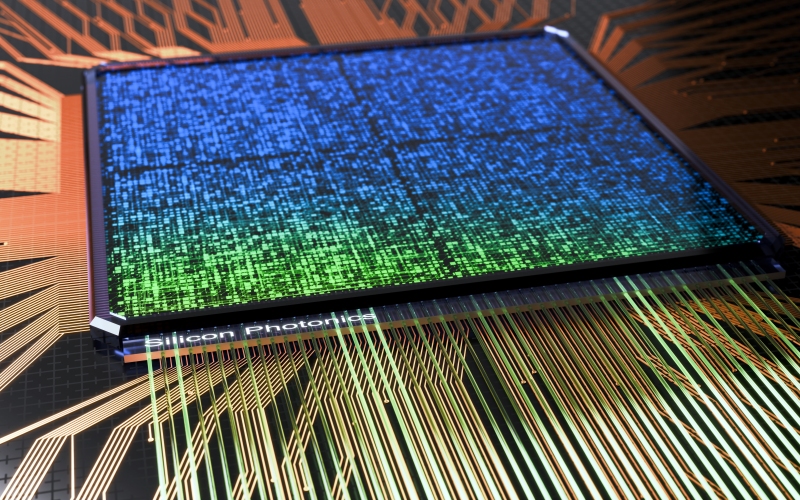
Copackaged optics addresses these constraints at their source by relocating the electrical-to-optical conversion function from the front panel to the switch package itself. The optical engines in a copackaged optics assembly share a package substrate with the switch application-specific integrated circuit, reducing the electrical path between the two from centimetres to hundreds of micrometres.
The architectural consequences of that distance reduction are substantial:
Lower SerDes power
The shorter electrical path requires significantly less drive power to maintain signal integrity, reducing total system power consumption by an estimated 30 to 50 percent at equivalent bandwidth compared to pluggable architectures
Higher lane speeds
The signal integrity advantages of the short electrical path enable higher per-lane data rates without the equalisation complexity that long PCB traces demand
Greater bandwidth density
Removing pluggable cages from the front panel frees physical space for additional switching capacity or improved thermal management
Reduced thermal footprint
Distributing optical engine heat across the package rather than concentrating it at front-panel cages enables more efficient system-level thermal management
The Trade-offs That Traditional Interconnects Avoid
The performance advantages of copackaged optics come with integration challenges that pluggable architectures are specifically designed to avoid. Field replaceability is the most significant. A pluggable transceiver that fails can be swapped in minutes without taking the switch offline. A failed optical engine in a copackaged optics assembly is not field-replaceable in the same way, placing greater demands on the reliability and yield of the assembly process.
Testing is similarly more complex. Pluggable transceivers are tested as independent modules before installation and can be returned for repair or replacement. Copackaged optics assemblies must be tested as integrated systems, requiring more sophisticated test infrastructure and more careful yield management across each integration step.
Singapore’s copackaged optics manufacturing sector has invested in addressing exactly these challenges, developing assembly and test capabilities that support the reliability and yield requirements of hyperscale data centre customers for whom operational uptime is a non-negotiable constraint.
Standardisation and Ecosystem Maturity
The pluggable transceiver ecosystem benefits from decades of standardisation work through bodies such as the Multi-Source Agreement process, which has created interoperable form factors deployable across a broad range of switch and router platforms. That ecosystem maturity is a genuine advantage that copackaged optics has not yet fully replicated.
Standardisation efforts for copackaged optics are progressing, with industry groups working to define common optical interface specifications and assembly standards that will enable broader interoperability. The pace of that work has accelerated as hyperscale operators have committed to copackaged optics deployments and begun applying their considerable purchasing influence to the standardisation process.
Conclusion
The comparison between copackaged optics and traditional interconnects is not a straightforward contest with a single winner. Traditional pluggable architectures offer field replaceability, ecosystem maturity, and operational simplicity that remain genuinely valuable. Copackaged optics offers power efficiency, bandwidth density, and signal integrity performance that pluggable architectures cannot match at the highest data rates. The question for data centre operators and switch designers is not which architecture is better in the abstract, but which architecture is better matched to the specific bandwidth, power, and operational requirements of the infrastructure they are building. At the leading edge of that infrastructure in 2026, the answer is increasingly pointing toward copackaged optics.

