
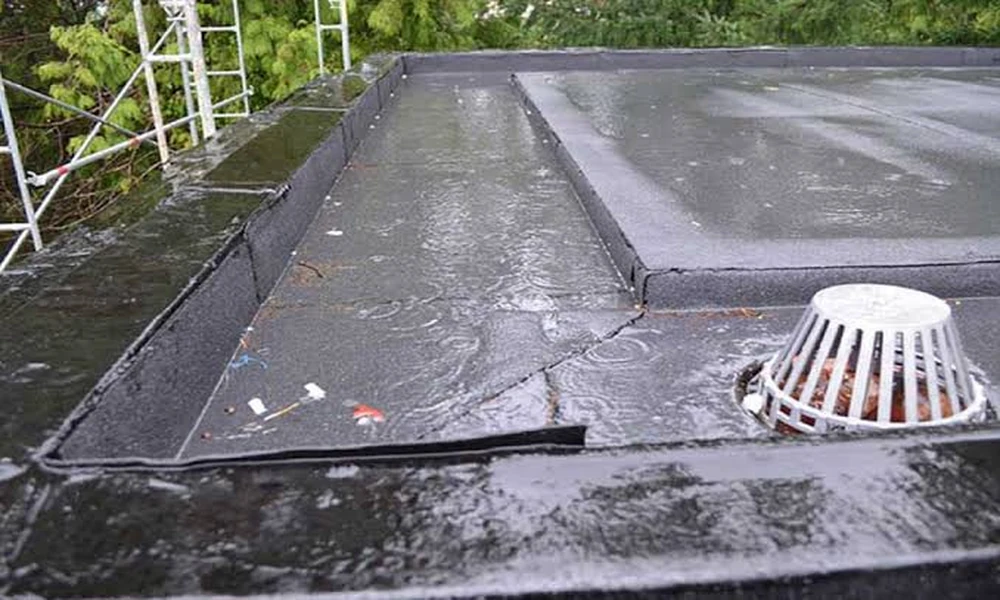
Picture a Monday morning after a weekend storm. The parking lot is fine and the lobby is dry, but a stain is spreading across a ceiling tile in the back office. The roof membrane looks intact, so where is the water coming from?
In many commercial buildings, the answer isn’t the roofing material. It’s what happens to the water after it lands. A commercial roof is a water management system: surface, slope, drains, scuppers, gutters, and downspouts. When one part fails, the whole system suffers.
Why Flat and Low-Slope Roofs Behave Differently
Residential roofs shed water quickly because of their steep pitch. Most commercial buildings use flat or low-slope roofs, which rely on engineered drainage to move water off the surface. That design brings a few built-in challenges:
- Water lingers. Even a well-designed low-slope roof can hold moisture for 48 hours or more after rain.
- Weight adds up. Standing water is heavy, and a few inches across a large roof area can stress the structure.
- Small flaws grow. A hairline seam gap that would be harmless on a steep roof can become a steady leak path when water sits on it.
This is why commercial roofing is as much about hydraulics as materials.
The Four Components That Decide Whether Your Roof Drains Properly
1. Slope and tapered insulation. Many low-slope roofs use tapered insulation to create a gentle fall toward drains. If the slope was never right, or the deck has settled, ponding follows.
2. Roof drains and sumps. Interior drains are the heart of most flat-roof systems. Leaves, grit, and debris from rooftop equipment are the most common culprits when they clog.
3. Scuppers and overflow outlets. These are your safety valve. If the primary drains back up, overflow scuppers keep water from rising to a level that overwhelms flashing and parapet walls.
4. Internal piping. Where roof drains connect to the building’s storm lines, the roof and the plumbing become one system. A blockage, a crushed section, or a poor joint underground can send water backing up toward the roof, and the roof often gets the blame for a problem that actually lives in the pipes.
Where Roofing and Plumbing Overlap
A good commercial roofing contractor understands that a roof’s performance depends on how well it’s connected to the building’s drainage infrastructure. That’s the approach behind Byler Commercial Roofing Service: treating the roof, its drainage hardware, and the related piping as parts of one system rather than separate repair jobs.
This matters most in situations like these:
- Repeated “mystery” leaks that return after patching.
- Water backing up in drains during heavy rain even though the roof surface is sound.
- Rooftop HVAC condensate lines that discharge in the wrong place and keep one area permanently wet.
- Older buildings where storm drain lines have aged separately from the roof above them.
Fixing the membrane alone in these cases treats the symptom, not the cause.
A Seasonal Walk-Through Every Building Owner Can Do
You don’t need to climb on the roof yourself (and for safety reasons, you shouldn’t). But you can ask your facilities team or contractor to check these items each season:
Before fall leaf drop
- Clear drains, strainers, and gutters.
- Check that scupper openings are free of obstructions.
After winter
- Look for freeze-thaw damage at seams, flashing, and parapet caps.
- Inspect drain bowls for cracking.
Before the heavy-rain season
- Confirm overflow outlets are open.
- Look for ponding areas that remain wet well after rainfall.
After any major storm
- Check ceilings and walls inside for new staining.
- Walk the building perimeter to see whether downspouts are discharging away from the foundation.
The Cost of Waiting
Trapped moisture rarely announces itself. It travels through insulation, soaks the deck, and can lead to corrosion, mold, and compromised insulation value long before a drip appears indoors. By then, what could have been a drain cleaning or a flashing repair may have become a partial roof replacement.
Industry standards can guide your expectations. The National Roofing Contractors Association (NRCA) publishes widely referenced guidance on roof system design, drainage, and maintenance, and it’s a good benchmark when you’re reviewing a contractor’s recommendations.
Questions to Ask Before Hiring a Contractor
- Will you inspect the drainage components and connected piping, or only the roof surface?
- How do you diagnose recurring leaks that previous repairs didn’t solve?
- What documentation (photos, moisture readings, written findings) will I receive?
- Do you offer a maintenance plan, not just emergency repair?
A contractor who answers these clearly is looking at your building as a whole system, which is exactly what a commercial roof demands.
The Bottom Line
A roof that keeps water out is only half the job. A roof that also moves water away efficiently, through clear drains, correct slope, and healthy piping, is what protects a commercial building for decades. Treat your roof as a water management system, inspect it with that mindset, and you’ll catch problems while they’re still small and inexpensive.

