
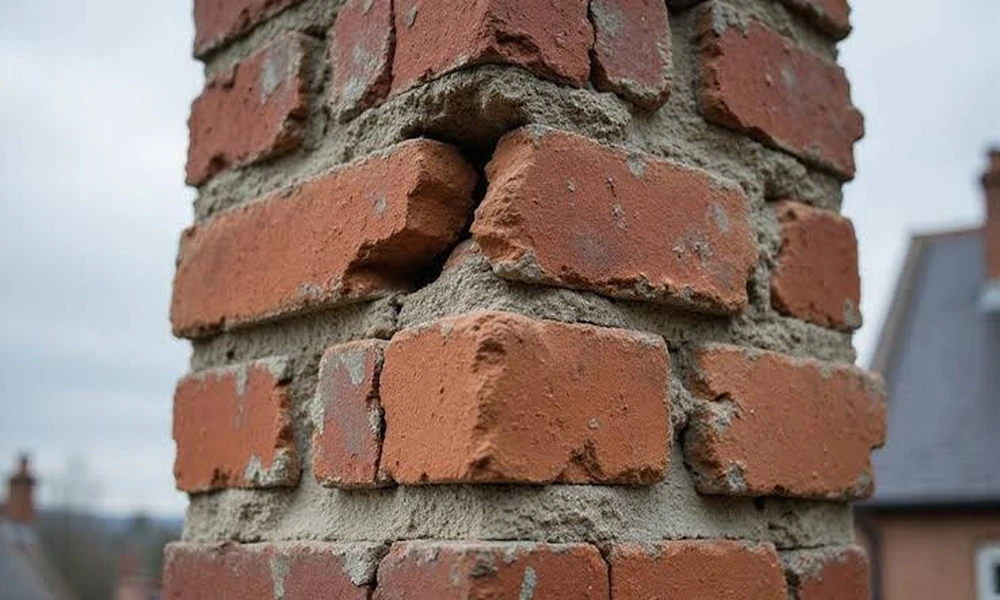
Most chimneys don’t die of old age. They die of water.
That sounds overly simple until you’ve seen what happens to a brick stack after a decade of Florida rain. People assume a chimney is a solid stone column that just gradually wears out. In reality, it’s a layered assembly of brick, mortar, flashing, and cap, and every layer has a job. One fails, and the rest follow. If you’ve noticed a stain on the ceiling near the fireplace, or a brick that crumbles when you touch it, you’re not dealing with a cosmetic problem. Something in that assembly has already given up.
Here’s the good news: the failure almost always follows a predictable script. Once you know the four things that wreck a chimney, you can walk outside, look at yours, and spot trouble long before it reaches your living room. And if you’d rather skip the guessing, chimney repair in Jacksonville covers the exact damage this climate produces, from crumbling mortar to leaking flashing.
What Kills a Brick Chimney First
Water. Not fire, not time, not that one winter you skipped the flue. Water.
Brick is porous. It acts like a sponge, absorbing rain through the face and the mortar joints. When the sun comes out, that moisture needs somewhere to go, and it tries to leave through the surface. The tiny pores in the brick clog with dissolved salts, the water pushes outward, and a thin layer of brick face pops off. That’s spalling. Once it starts, the brick is thinner, absorbs more water, and the cycle speeds up.
Freezes finish the job in colder climates, but Jacksonville has a different engine: constant humidity, driving rain, and sun that bakes saturated masonry. I’ve seen chimneys here look fine at eye level and feel like soft cake at the shoulder. That’s not neglect. That’s a cap issue nobody noticed for years.
Waterproofing, in plain terms
A penetrating breathable sealer slows absorption without trapping moisture inside. Do it wrong, with a film-forming paint-like product, and you’ve sealed the sponge in a plastic bag. The water stays in, finds the weakest brick, and blows it apart. So yes, waterproofing helps. The product matters more than the label.
The Chimney Cap Does More Than Look Nice
Think of a cap as a tiny roof for your chimney. It sheds rain off the crown, keeps birds and squirrels out, and stops sparks from hitting the shingles. Skip it and you’re inviting water straight down the flue in a storm.
A missing or rusted-out cap is probably the single most common problem I’d look for on any house older than twenty years. The catch is that caps fail quietly. A cheap galvanized cap starts rusting from the inside, looks fine from the driveway, and drops screws in a windstorm nobody thinks about. Stainless steel caps cost more upfront and last dramatically longer, and that’s the version I’d put on my own house every time.
While you’re up there, look at the crown, the sloped concrete top around the flue. Hairline cracks let water seep in, where it freezes, expands, and lifts the whole crown loose. A cracked crown is a slow leak that shows up as a brown ring on your ceiling months later.
Why Flashing Fails Where the Roof Meets the Chimney
This is the spot most homeowners blame on the chimney when the real culprit is the roof, or the other way around. Flashing is the metal that seals the seam where the chimney penetrates the roof, and it’s the hardest joint on the whole house to get right.
Tar or sealant patches are a warning sign. If you see a smear of black goo around the base of your chimney, someone tried to fix a flashing leak the fast way, and that repair never lasts. Proper flashing is layered into the shingles, with counter-flashing set into a mortar joint. It’s genuinely fiddly work.
Wind-driven rain on the southeast side of a chimney is the usual suspect, and in a place with afternoon storms most of the year, that joint gets tested constantly. The Department of Energy notes that uncontrolled moisture is one of the biggest drivers of premature building material failure, which is exactly what’s happening when water slips past a bad flashing job.
A quick flashing check
- Look for rust streaks running down the chimney face
- Feel for soft wood on the roof deck near the chimney
- Check your attic for stains directly below the chimney line after a storm
- Note any black sealant smeared around the base
Any one of those is worth a professional eye. Two or more and you likely have active water intrusion.
How Long Should a Masonry Chimney Actually Last?
A well-built, well-maintained brick chimney can serve a house for decades, and a neglected one can start failing inside fifteen years. The gap isn’t luck. It comes down to whether anyone ever looked at it.
Here’s where it gets interesting. Apex predators of a chimney aren’t dramatic chimney fires. They’re the boring maintenance items: caps, crowns, flashing, and joints. According to the National Fire Protection Association, chimneys and flues should be inspected on a regular schedule, and annual inspections are a widely accepted baseline for anyone who uses a fireplace. That inspection is how you catch a cracked crown before it costs you a ceiling.
Chimney fires do happen, and the Environmental Protection Agency points to creosote buildup from burning unseasoned wood as a major contributor. Burn dry wood, get it swept, and you remove most of that risk. This part is honestly pretty easy to control.
The Homeowner’s Chimney Audit
Here’s a routine I’d hand to any homeowner. Call it the Four Seasons Check: you do it once each season, and it takes fifteen minutes.
| Season | What you look at | What worries you |
|---|---|---|
| Spring | Brick faces after heavy rain | Flaking, white powder, soft spots |
| Summer | Crown and cap from the ground with binoculars | Cracks, rust, missing cap |
| Fall | Flashing and roof seam | Black sealant, lifted metal, dark shingles |
| Winter | Interior ceiling and attic near the chimney | Stains, damp smell, peeling paint |
Write the date and what you see. A photo log is surprisingly useful, because damage is gradual and your memory of “it looked fine last year” is not reliable. If you spot something in two different seasons, stop watching and call someone.
One thing I’d push back on: don’t climb up there yourself. A wet Florida roof is unforgiving, and a chimney inspection isn’t worth a fall. Binoculars from the yard and a flashlight in the attic get you most of the way.
When to Repair and When to Rebuild
Small stuff gets repaired. Cracked crown, failed cap, isolated spalling, patched flashing. These are straightforward jobs and worth doing early.
Big stuff gets rebuilt. If the mortar joints are deeply recessed across the whole stack, or the bricks crumble into your hand, you’re looking at a partial or full rebuild from the roofline up. Leaning chimneys and missing flue tiles fall in the same bucket, and no sealant fixes structural problems.
The trick is honest assessment. A contractor who only patches is just delaying your rebuild, and one who quotes a full rebuild for a cracked crown is charging you for the dramatic option. Ask what else they found, and get a straight answer about what’s repairable now and what has a short clock on it.
Your chimney is the one part of the house that takes weather from every direction and almost never gets looked at. Fifteen minutes a season changes that. So go outside, look at the cap, and check the flashing. If it’s been more than a year since anyone actually inspected it, schedule the visit, and let a pro tell you whether it’s a patch or a rebuild. What did you see up there?

